|
|
|
AstroMax |
|||
|
www.AstroMax.org |
|||||
|
|
|||||
| ||||||||||
|
Dr. Paul Butler at Keck Observatory Title: Extrasolar Planets: First Reconnaissance
The planets detected to date have profoundly challenged the theories of planet formation, including Jupiter-mass planets in very small (4 day) orbits, and Jupiter-mass planets in non-circular, eccentric, orbits. Only the systems orbiting 47 Ursae Majoris and HD 27442, with Jupiter-mass companions in circular orbits, reminds us of the Solar System. Now that planets have been detected, we would like to know what fraction of stars have planets, what fraction of planetary systems are similar to the Solar System, and how many other types of planetary systems exist. Toward this goal our group is surveying the 1000 nearest and brightest Sun-like stars in the northern hemisphere using the Lick 3-m (California) and Keck 10-m (Hawaii) Telescopes. In addition we are surveying the 200 brightest southern hemisphere stars from the 3.9-m Anglo-Australian Telescope. Next year we will begin surveying the remaining nearby southern hemisphere stars from the 6.5-m Magellan Telescope in Chile. These surveys are the only active program capable of detecting "Solar System-like" planets. By 2010 these surveys will provide a first planetary census of nearby stars, allowing us to estimate the ubiquity of planetary systems and of "Solar System" analogs. Go to the Crane Observatory Page |
| |||||||||||




 Learn
the Constellations
Learn
the Constellations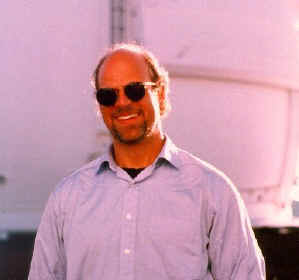 Abstract: