LEONIDS 2000 - November 17, 2000
Find out more about the Leonids
2000 Event
Below is my write-up for my Leonid 2000 observations. AAAA is a wonderful
astronomical club and astronomy is the best hobby anyone can experience. I’ll
be on the front lines once again next year for the much anticipated east coast
meteor storm predicted to occur on the morning of the November 18th. You can
count on me for observations and photo data in 2001 and 2002.
Ron Zincone, Richmond, RI
[email protected]
|
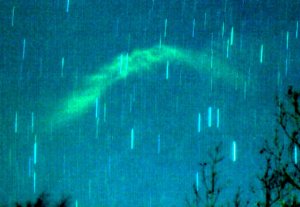
Photo #1 - Leonid Fireball Smoke Trail. Location: Richmond, RI. Date:
November 18, 2000. Time: 3:05 am EST. Lens: 50mm. F/stop: 2.8. Film:
Fujichrome Provia 1600. Exposure: 3 to 5 minutes. Photo by Ron Zincone |
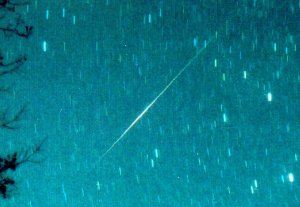
Photo #2 - Leonid Meteor in Northern Sky. Location: Richmond, RI.
Date: November 18, 2000. Time: Estimated around 4 am. Lens: 50mm. F/Stop:
2.8. Film: Fujichrome Provia 1600. Exposure: 1 to 3 minutes. Photo by Ron
Zincone. |
Leonid 2000 Observations
This year’s meteor shower was the greatest meteor experience and one of the
best astronomical events I have ever witnessed. On the morning of the 17th I was
up in North Conway, NH. I observed under the 1 st quarter moon sky from around
1:30 am to about 4:30 am EST under mostly clear skies. I visually counted about
42 bright Leonid Meteors, mostly greenish-white in color. The peak occurred
around 2:50 to 3:00 am; which was as predicted.
On the morning of the 18th, I observed from my home in Richmond, RI, under
totally clear skies with the 1st quarter moon. I visually counted from around
1:30am to about 4:50 am 217 bright Leonids! Most were greenish-white in color. I
am sure I didn’t catch any of the fainter ones since the 1st quarter moon
washed them out and many others Leonids may have appeared in other areas of the
sky I did not concentrate on.
My estimate of the average hourly rate was around 100, but the more true ZHR
was probably closer to 200 to 300. A minor peak seemed to occur around 2:40 am
and a much greater peak around 2:58 am, when I saw a fabulous Leonid fireball
that had to be at least mag. -3 to mag. -4. It was in the Northwest sky and left
a glowing worm-like trail for 5 minutes! At this peak time, the meteors came in
pairs and some three in a row! Most of the meteors I visualized and caught on
film were from the darker regions of the sky away from the moon, mainly the SW,
West, NW and Northern sky areas.
Out of 108 shots on Provia 1600 film, I managed to capture a total of 7
Leonid meteors and one fireball smoke trail. The best Leonid of the 7 was
captured in the Northern sky around 4 am. It was the greatest meteor shower and
one of the best astronomical events I have ever seen. I can’t imagine what
2001 and 2002 will bring.
Ron Zincone, Richmond, RI
AAAA member; ASSNE member
[email protected]
Links to Leonids 2000 Web Sites
Leonid
Peak Online Estimator: If you want to find out the estimated peak times for where you live, go to this site, and check out your location. At the bottom of the screen is a flux calculator. Pick the city closest to you and launch the calculator. It should give you a pretty good idea what the times will be for your area.
|




 Learn
the Constellations
Learn
the Constellations