The Makeup of Stars
ATOMS
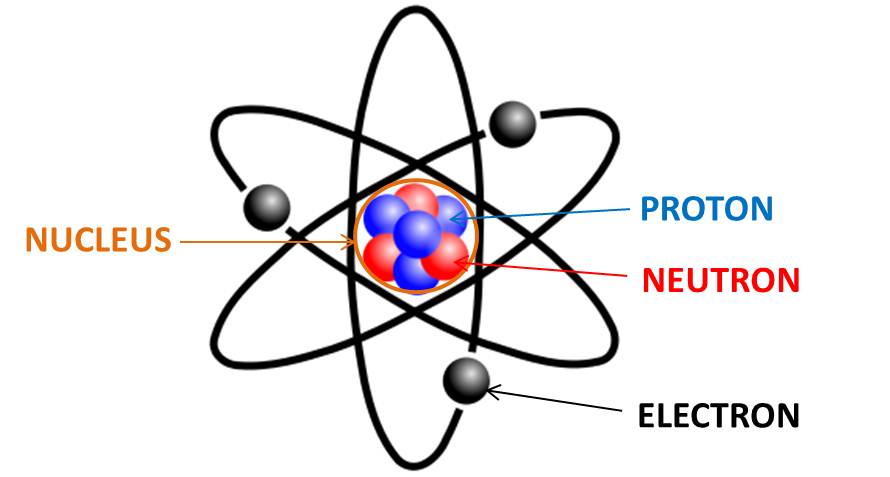
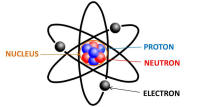 A. Atoms are composed of protons, neutrons and electrons. The
protons and neutrons are in the center of the atom, called the nucleus. The
electrons spin in a cloud about the nucleus, Protons have a positive electric
charge, electrons have a negative electric charge, and neutrons have no charge
at all. A. Atoms are composed of protons, neutrons and electrons. The
protons and neutrons are in the center of the atom, called the nucleus. The
electrons spin in a cloud about the nucleus, Protons have a positive electric
charge, electrons have a negative electric charge, and neutrons have no charge
at all.
B. The number of protons in the center of an atom is called the atom’s
atomic number. Thus, hydrogen has an atomic number one, carbon has an atomic
number 6, and so on.
C. Atoms can be positively ionized (more protons than electrons), negatively
ionized (more electrons than protons), or neutral (equal numbers of
protons and electrons). The number of neutrons plus the number of protons
is called the atomic mass. Therefore, helium, which has two
protons and two neutrons, has an atomic mass of four. D. All atoms larger than
hydrogen and helium have been made within the thermonuclear furnace of a star,
powered by nuclear fusion. This is the process in which smaller atoms,
i.e., hydrogen and helium, are smashed together to form larger elements, such as
carbon. The fusion process releases energy, which causes stars to radiate light
and heat. But fusion only creates atoms up to the size of iron (iron has atomic
number 26). Atoms larger than iron have been created by anther process, the
explosion of large stars, called supernova. The energy released in such
explosions is enough to create these larger species of atoms.
E. The electrons in atoms only orbit at certain definite levels, like stairs
on a staircase. These levels are determined by Quantum Mechanics. When light
hits an atom, it causes the electrons to jump from a lower stair, or lower
energy level, to a higher stair, or higher energy level. The atom only absorbs
light if it is of an energy that corresponds to the height between the lower and
higher energy level. Similarly, when atoms are very hot and bouncing into one
another, their electrons are excited into higher energy levels. When the
electrons fall back into their usual; energy levels, they only emit light of
certain energies, the energies that correspond to the differences between the
stairs. Thus, each type of atom has a unique way of absorbing and emitting
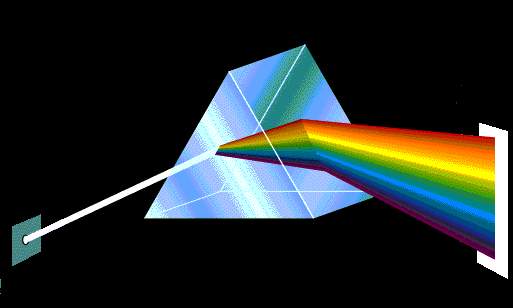
light. The colors of light that an atom emits are called its emission spectrum,
and the colors it absorbs are called its absorption spectrum.
F. All objects continuously emit light of some wavelength or another. This
radiation is usually outside of what humans can see. It is called blackbody
radiation because it refers to light emitted by an ideal object that is a
perfect absorber and emitter of radiation. When objects are hot enough to emit
light that is visible to humans, we can easily tell its relative temperature. As
the object increases in temperature, it goes from red to orange to yellow to
blue. The wavelength of the most common light emitted by the hot object is
called the wavelength of maximum intensity. From this wavelength, it is possible
to determine the surface temperature of the object.
THE PROPERTIES OF STARS
A. The stars are at such a great distance that normal units of measurement
are too unwieldy to use. Therefore, astronomers use light years and parsecs
to denote distances. A light year is the distance light travels in a year,
and is equivalent to about 5.9 trillion miles. A parsec is 3.26 light-years.
B. How bright a star appears to an observer on Earth is called its apparent
magnitude. However, stars are at different distances from the Earth, so a
measure of how bright they actually are, as opposed to how bright they appear,
is needed. This is called absolute visual magnitude, which is how
bright the star would appear if it were 10 parsecs away from earth.
C. The luminosity of a star is the total amount of' energy it emits in
a second. This is usually stated in comparison to the sun. For instance, the sun
has a luminosity of 4x10(26) J/sec. The star Capella has a luminosity of
4x10(28) J/sec. Therefore, Capella has 100 solar luminosities. or is 100 times
as luminous as the sun.
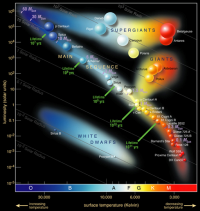 D. A star's spectrum can be classified by its light's spectrum. The stars are
then given the following classes: D. A star's spectrum can be classified by its light's spectrum. The stars are
then given the following classes:
I. Bright Super-giant
II. Super-giant
II.. Bright Giant
III. Giant
IV. Sub-giant
V. Main-sequence star
E. Binary Stars are stars that orbit one another. Binary stars
physically linked to one another by gravity are called visual binaries. Binary
stars that are not actually linked to one another, but appear to be, are called optical
binaries. Optical binaries occur when one star is closer to the Earth than
another, but they appear from our perspective to be close to one another.
F Stellar Densities: Stars range in density from very tenuous to very,
very dense. A very large star may have a density of 0.000001 g/cm(3). Our sun
has a density of about 1 g/cm(3), approximately that of water. A white
dwarf may have a density of 3,000,000 g/cm(3). At that density, one cubic
centimeter would weigh as much as a large truck.
 G.
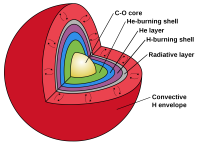
Stellar Evolution: Stars are powered by a hydrogen-fusion reaction.
When the raw fuel for this reaction runs out, its core contracts and heats up,
causing the hydrogen fusion shell to ignite. This, in turn, causes the star to
expand into a giant star. The contraction of the star's core may ignite the
helium that is left there. This helium burn may cause the star to start
fusing larger elements. If the star's mass is in the 0.3 to 3 solar masses
range, then its helium core will degenerate before the helium ignites. The
result is an explosion that is absorbed by the star. The method of evolution of
a star depends on its mass. G.
Stellar Evolution: Stars are powered by a hydrogen-fusion reaction.
When the raw fuel for this reaction runs out, its core contracts and heats up,
causing the hydrogen fusion shell to ignite. This, in turn, causes the star to
expand into a giant star. The contraction of the star's core may ignite the
helium that is left there. This helium burn may cause the star to start
fusing larger elements. If the star's mass is in the 0.3 to 3 solar masses
range, then its helium core will degenerate before the helium ignites. The
result is an explosion that is absorbed by the star. The method of evolution of
a star depends on its mass.
- Stars with less mass than 0.4 solar masses will evolve into white
dwarfs.
- Stars between 0.4 and 3 solar masses will become red giants and
then burn out into white dwarfs.
- Stars as massive as 6 solar masses may lose enough mass to eject planetary
nebulae, and then die as white dwarfs.
- When atoms grow up, they want to be iron. Iron atoms are the most tightly
bound of all atomic nuclei. Large stars can fuse atoms as large as iron, but can
go no further. When an iron core of a massive star collapses, a .supernova is
formed, which ejects massive amounts of energy into the surrounding space. Stars
that are more massive than 8 stellar masses eventually collapse explosively to
produce supernovae. Unless the star is larger than about 25 stellar
masses, what will be left is a neutron star. A neutron star is made by
the gravitational fusion of all the electrons and protons of the constituent
nova. When neutron stars emit radiation at regular intervals, they are known as pulsars.
- If a star has a mass larger than 25 solar masses, it collapses into a black
hole. A black hole is a gravitational singularity from which nothing, not
even light, can escape. However, black holes may be detected by the radiation
emitted from objects failing into them.
STAR LIGHT
There are three kinds of spectrums that interest astronomers.
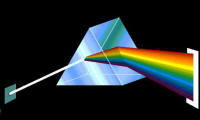 A. Continuous Spectra: The surface of a star is heated to such an
extent that it glows with a particular color. Red for cool stars, bluish-white
for very hot stars. Because the light emitted at the surface has been absorbed
and transmitted by many atoms before it reaches the surface, the discrete colors
of the atoms' emission spectra have been evened out to form a continuous
spectra. A. Continuous Spectra: The surface of a star is heated to such an
extent that it glows with a particular color. Red for cool stars, bluish-white
for very hot stars. Because the light emitted at the surface has been absorbed
and transmitted by many atoms before it reaches the surface, the discrete colors
of the atoms' emission spectra have been evened out to form a continuous
spectra.
B. Absorption Spectra: Are formed when continuous spectra from a star
shine through a gas that absorbs only certain colors of light. The absorption
spectra, therefore, looks like continuous spectra with dark bands at discrete
wavelengths.
C. Emission Spectra: Are given by gas that is in the outer parts of
stars, where the light is not absorbed and emitted many times before being
transmitted to space. An emission spectrum is usually just a few colored bands
corresponding to the wavelengths of the emitted light.
|




 Learn
the Constellations
Learn
the Constellations